Search has changed more in the last three years than in the previous two decades. People no longer type short keywords and scroll through ten blue links. They ask full, conversational questions and get direct answers from AI. If you are still writing content the way you did in 2022, you are losing visibility, possibly without knowing it.
Learning how to optimize content for AI search engines is now essential for marketers, agencies, and business owners who want to stay visible in 2027. This guide covers Generative Engine Optimization (GEO), Answer Engine Optimization (AEO), and how traditional SEO fits in. It also gives you a practical framework for Google AI Overviews, ChatGPT search, Perplexity, and other AI answer platforms.
Why AI Search Engines Are Reshaping Content Strategy
Ranking on page one of Google used to be the ultimate goal. Today AI Overviews, ChatGPT search, Perplexity, and other generative tools answer questions directly, often without a click to any website. This zero-click shift means visibility now depends on whether AI systems can understand, extract, and trust your content.
An AI search engine does not just return links. It pulls information from multiple sources, writes a conversational answer, and sometimes cites where it got the facts. If your content is not structured for that process, you will not appear in the answer.
This is not a temporary trend. Conversational search and natural language queries are now the default, especially for younger users. If your content strategy for AI search does not evolve with them, your organic visibility will decline even if your rankings look fine on paper.
What Does It Mean to Optimize Content for AI Search Engines?
To optimize content for AI search engines means structuring, writing, and technically preparing your content so generative AI systems can understand it, trust it, and use it to answer user questions. It combines content quality, technical SEO, structured data, and authority building.
Traditional SEO aimed to rank in a list of links. AI search optimization aims to make you the source the AI chooses to cite. You are writing to become a trusted, citable reference, not just to hold a ranking position.
Most people asking how to optimize for AI search want to know three things:
- How do I make my content easy for AI to read and extract?
- How do I build enough authority that AI models cite me?
- How do I stay visible when clicks aren’t guaranteed?
GEO vs AEO vs SEO: What’s the Difference?
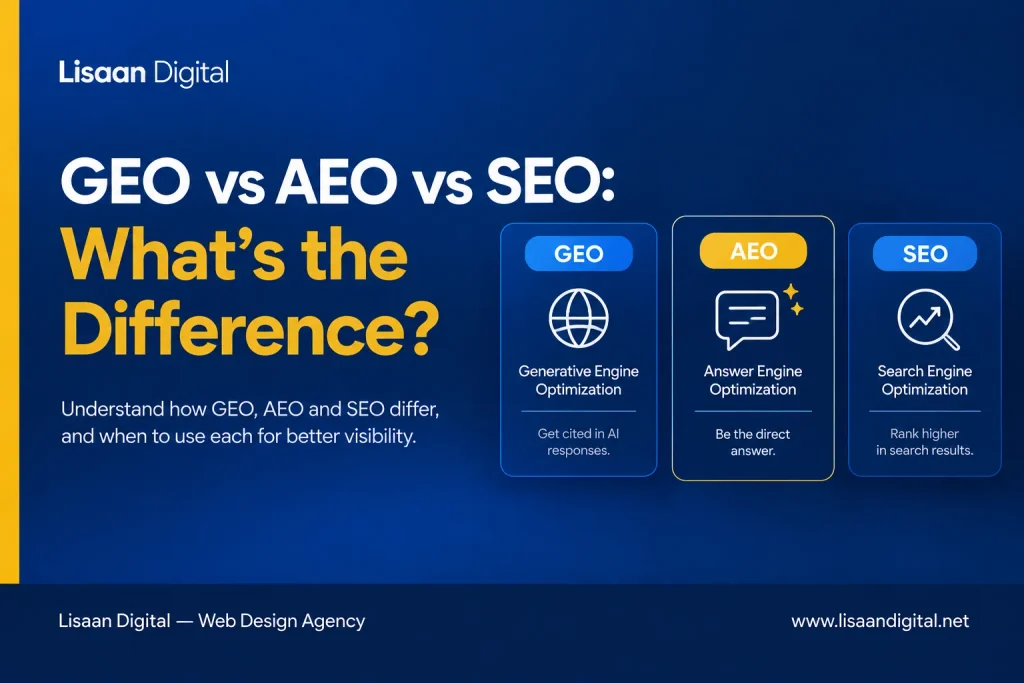
These three terms are often mixed up, but they mean different things.
Search Engine Optimization (SEO) is the discipline of ranking higher in search results through keyword research, on-page SEO, technical SEO, link building, and content quality.
Answer Engine Optimization (AEO) focuses on appearing as the direct answer to question-based queries, such as featured snippets, voice search results, and “People Also Ask” boxes.
Generative Engine Optimization (GEO) is the newest discipline. It optimizes content so generative AI systems like Google AI Overviews, ChatGPT search, and Perplexity can understand, summarize, and cite it accurately.
You don’t choose between them. Technical SEO makes your site crawlable, AEO makes your content answer-ready, and GEO makes it citation-ready. The strongest AI search optimization strategy in 2027 blends all three.
How AI Search Engines Choose What to Cite
Every effective AI SEO strategy starts with understanding how these systems pick sources. Most follow four stages:
- Query interpretation. The AI reads the natural language query to understand intent, not just literal keywords. A search like “best CRM for a small marketing agency” implies budget, team size, and integration needs.
- Retrieval. The system pulls relevant pages using semantic search plus traditional ranking signals. This is why crawlability and indexability still matter.
- Evaluation. The model checks the retrieved content for relevance, clarity, and trustworthiness. Well-structured, accurate, easy-to-extract content wins.
- Citation. Some AI engines link or name the sources they used. Earning these citations is one of the clearest signs your AI search optimization is working.
The 5 Pillars of AI Search Optimization
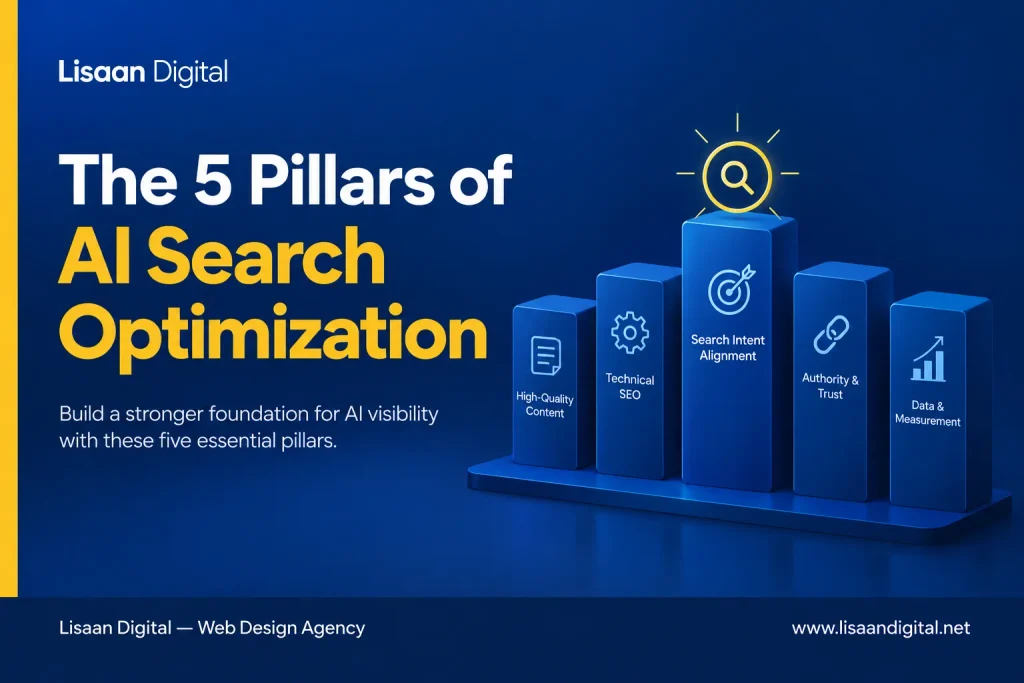
1. Clarity and structure. Use descriptive headings, short paragraphs, and direct answers at the start of each section. Never bury the answer three paragraphs deep.
2. Factual accuracy. AI engines avoid outdated statistics, unverifiable claims, and inconsistent information. Verify every stat, date, and figure before publishing.
3. Semantic depth. AI understands meaning, not just keywords. Cover related entities and subtopics thoroughly instead of repeating one phrase.
4. Structured data. Schema markup tells crawlers what your content is, who wrote it, and how it is organized. It is one of the most underused levers for AI search visibility.
5. Authority and trust (E-E-A-T). Experience, Expertise, Authoritativeness, and Trustworthiness matter more than ever, because AI models prioritize sources with real expertise and a reliable track record.
Technical SEO Foundations That Still Matter
AI search optimization does not replace technical SEO. AI crawlers still need to access and index your content before they can cite it. Prioritize:
- Crawlability: don’t block important pages with robots.txt or broken internal links.
- Indexability: confirm key pages are indexed, not just crawled, using Google Search Console.
- Page speed and Core Web Vitals: slow pages frustrate users and crawlers.
- Mobile responsiveness: most conversational queries happen on mobile.
- Clean URL structure: descriptive URLs help systems understand page context.
- Internal linking: strong linking shows relationships between pages and builds topical authority.
How to Write Content AI Models Want to Quote
Answer the question immediately. When a subheading is a question, answer it in the first one or two sentences. This mirrors how featured snippets and AI answers are extracted.
Use natural language, not keyword stuffing. Write the way a knowledgeable person speaks. Natural content is easier for AI to summarize, while stuffed keywords create low-quality sentences AI avoids citing.
Prioritize people-first content. Google’s helpful content guidance is here to stay. Content built to manipulate rankings underperforms in both traditional and AI search.
Target long-tail and question-based keywords. These mirror how people talk to AI assistants. Build sections around the specific questions your audience asks.
Keep paragraphs short and scannable. Aim for two to four sentences, and use bullet points where they help.
Schema Markup for AI Search Visibility
Structured data gives search engines and AI crawlers explicit, machine-readable context. The highest-priority schema types for most content sites are:
- Article schema: clarifies authorship, publish date, and content type
- FAQPage schema: helps question-based content surface in AI answers and featured snippets
- HowTo schema: for step-by-step guides
- Organization and Person schema: reinforces brand identity and authorship for E-E-A-T
- BreadcrumbList schema: clarifies site structure and hierarchy
Schema doesn’t guarantee a citation, but it removes ambiguity and meaningfully improves your odds.
Building Topical Authority and Entity Optimization
AI search engines think in entities and relationships, not isolated keywords. Entity optimization means clearly establishing who you are, what your brand stands for, and how your content connects to a wider topic cluster.
- Cover each subject from multiple angles, not one narrow keyword
- Interlink related articles to show how your content fits together
- Use consistent, unambiguous names for your brand, products, and concepts
- Reference credible external sources to reinforce accuracy
- Keep your website, business listings, and social profiles consistent so your entity is easy to verify
E-E-A-T: Why Trust Signals Matter More for AI Search
E-E-A-T has moved from a nice-to-have to a core requirement. Because generative AI synthesizes information instead of just linking, the risk of citing an unreliable source is higher, so these systems are more selective. To strengthen it:
- Publish author bios that show real experience and expertise
- Cite credible sources and data instead of unverified claims
- Update content as facts and best practices change
- Earn genuine brand mentions from reputable websites
- Be transparent about who created the content and why they’re qualified
No amount of technical optimization can rescue shallow, outdated, or misleading content.
Traditional SEO vs AI Search Optimization
| Factor | Traditional SEO | AI Search Optimization (GEO/AEO) |
|---|---|---|
| Primary goal | Rank in top results | Get cited in AI-generated answers |
| Main signal | Keywords, backlinks, rankings | Clarity, accuracy, structured data, trust |
| Content format | Long-form keyword-targeted pages | Direct answers, scannable, entity-rich content |
| User behavior | Click through to site | Often zero-click |
| Success metric | Rankings, organic traffic | AI citations, brand mentions, referral visibility |
| Technical priority | Crawlability, indexability, speed | Same, plus schema markup |
| Content style | Keyword-optimized copy | Natural, people-first language |
| Authority signal | Backlinks, domain authority | E-E-A-T, entity consistency, topical authority |
AI search optimization builds on traditional SEO. You still need the technical fundamentals, with structured data, entity optimization, and answer-ready formatting layered on top.
Common Mistakes That Hurt AI Search Visibility
- Burying the answer under long introductions
- Ignoring structured data, which makes content harder to interpret
- Chasing keyword volume over search intent
- Neglecting technical SEO, so crawlers can’t access your pages
- Publishing outdated information
- Weak or missing author credentials
- Overcomplicated, jargon-heavy writing that is harder to summarize
AI Search Optimization Checklist
Run through this before you publish:
- Does each section answer a clear question in its first sentences?
- Are the primary keyword and related long-tail keywords used naturally?
- Is FAQPage or Article schema implemented correctly?
- Are headings descriptive and in a logical hierarchy?
- Is the content accurate, current, and sourced?
- Is there clear author information supporting E-E-A-T?
- Does internal linking connect related content?
- Is the page crawlable, indexable, and fast?
- Are paragraphs short and written in natural language?
- Does it genuinely help the reader, regardless of rankings?
The Future of AI Search Beyond 2027
AI search is heading toward deeper personalization and multi-turn conversations. Users refine questions in real time and expect the AI to remember context. Your AI SEO strategy will need to cover entire conversational journeys, not isolated keywords.
Voice search, multimodal search combining text and images, and smarter semantic search will keep pushing content toward being clearer, more structured, and more helpful. Brands that treat AI search optimization as an ongoing discipline will keep their organic visibility as the landscape evolves.
Conclusion
Knowing how to optimize content for AI search engines is one of the most valuable skills a marketer or business owner can build right now. Generative AI, conversational search, and zero-click results are a fundamental change in how people find information.
Combine strong technical SEO, schema markup, entity optimization, and people-first content, and you position your brand to earn AI citations and keep organic visibility long term. The core idea is simple: be genuinely worth citing, and the technical details will carry the rest.
Ready to Show Up in AI-Generated Answers?
Lisaan Digital helps businesses build AI-ready content strategies, from technical SEO audits and schema markup to full content overhauls. Contact Lisaan Digital today and start optimizing your content for the AI search era.
Chat On Whatsapp